
Best Sock Material for Sweaty Feet: 5 Fabrics That Keep You Dry
We’ve all been there. New socks, fresh out of the drawer – and boom, an hour in, your feet are roasting, clammy, and getting a bit whiffy. And what does everyone blame? Their own sweating. But honestly? It’s probably not you. It’s your socks.
The real culprit is almost always the material. Cotton is good for a lot of things, but when it comes to comfort for your feet, it can actually make things worse. Moisture management is very different depending on the material. Pick the right one and you’ll experience less heat, less slip and a lot less odour. Pick the wrong one, and you’re basically soaking your feet all day.
This guide is going to walk you through exactly what the best sock material for sweaty feet really is. We’ll walk you through the five best options, why they work, and how to match them to your daily life. No fluff, just practical tips.
Why Your Feet Sweat So Much Inside Socks
Before we jump into the fabrics, let’s take one minute to understand what’s going on inside your shoes. This will make the rest of the article click into place.
Your feet have more sweat glands than you think
There are about 250,000 sweat glands on the bottom of each foot. That’s a higher density than anywhere else on your body. Feet are literally built to perspire. Sweating is a natural cooling system, but when your feet are trapped in shoes, that moisture can’t evaporate quickly. So it just sits there, making everything damp.
Why shoes trap heat and moisture
Most shoes, especially trainers or leather shoes, aren’t designed for maximum airflow. Shoes, first and foremost, have to survive. They’ve got to be tough, take a beating – so breathability? Yeah, that takes a backseat. The result? Your foot ends up sealed inside a tiny greenhouse. Nice and stuffy.
You move, you generate heat, the temperature climbs, and your sweat glands get the memo: “Cool this down, stat!” And they do – by pumping out more sweat. Which, of course, makes it even more humid. A beautiful little cycle. They work harder. And that creates a loop: more heat, more sweat, more heat.
Why cotton socks make sweating worse
Here’s the big one. Cotton really soaks up moisture. It works like a soft towel, drawing sweat away from your skin. But that’s where the good news stops. Cotton fibres swell up when they are wet. That swelling blocks the gaps between threads, trapping water against your foot. Instead of drying, your feet end up sitting in a cold, wet wrap.
That’s a perfect breeding ground for bacteria and fungi, which is exactly why cotton-heavy socks are often linked to foot odor and athlete’s foot. Almost every expert guide on sweaty feet will tell you the same thing: stay away from 100% cotton socks.
5 Best Sock Materials for Sweaty Feet
If you know the problem, the solution is pretty cut and dry. You need a fabric that will move the moisture away quickly and let it off to the outside to evaporate. Here are five tried and true options, each with their own merits.
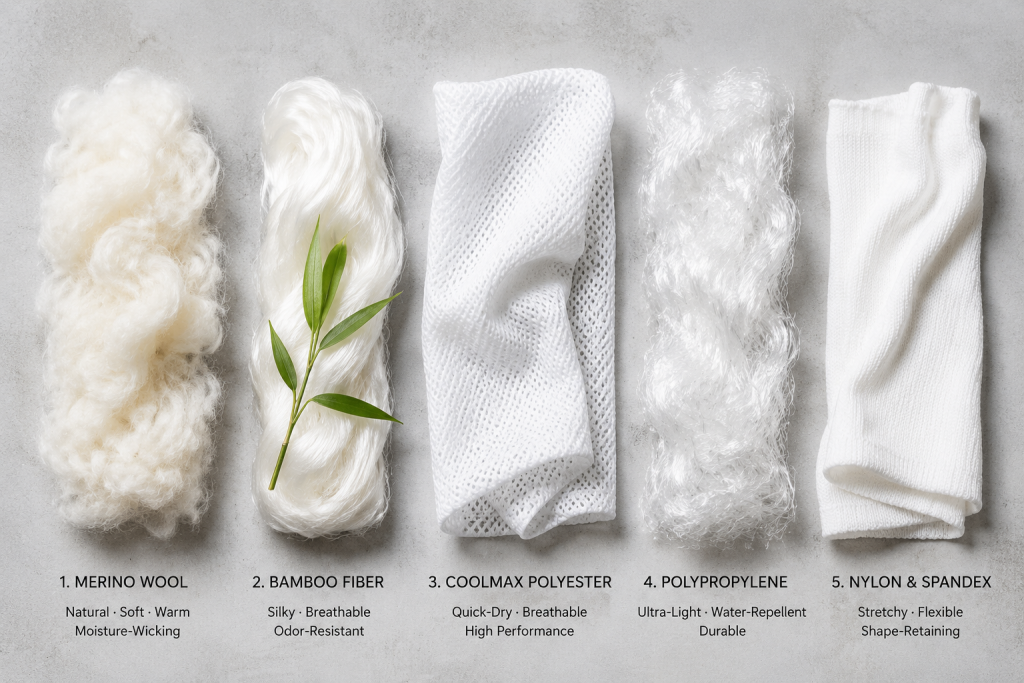
1. Merino Wool
What it is
It’s a superfine wool, from a particular breed of sheep. The fibres are much finer than wool, so they feel soft to your skin, not itchy.
Why it works?
Merino is like a built-in thermostat. The fibres contain tiny air pockets that can soak up to 30 per cent of their weight in moisture but feel dry on the surface next to your skin. It is drawn to sweat vapour and pulls it to the open air in a breathing action. Plus wool naturally contains lanolin which has mild antibacterial properties. Less odour, even after a long day at work.
If you are going to buy one kind of sock to wear all year round, get a blend with at least 60 per cent merino wool. It’s comfortable, odour resistant, and functions in nearly any situation. Lots of premium hiking and everyday brands rely on this as their go-to material.
2. Bamboo Fiber
What it is
Bamboo fibre is the fibre of regenerated cellulose made from bamboo pulp. It’s an environmentally friendly choice.
How it operates
Bamboo fibre presents porous structure under the microscope with irregular shape and oval shape. So it’s very absorbent and very breathable. It actually wicks sweat better than cotton does. Bamboo also has a natural antibacterial quality, so it keeps odor‑causing bacteria in check. And the feel? Honestly, it’s almost like silk – incredibly soft and smooth.
If you’re after that buttery‑soft touch with built‑in antimicrobial protection, bamboo socks are a solid pick. They’re especially good for office days or anytime you’re standing or walking for long stretches.
3. Coolmax & Polyester
What it is
Coolmax is a patented functional polyester fiber developed by DuPont. It’s a synthetic material engineered specifically for moisture management.
How it works
It’s the perfect performance fabric for wicking sweat. Coolmax fibres have special channels on the surface to create a four channel construction. The design employs a small pump and capillary action to wick moisture off your skin and to the outer layer of the sock. 3-5 times faster than cotton drying speed. When sweat makes it to the outside it evaporates quickly and your feet are a lot drier.
If you are a serious athlete, runner or spend a lot of time in hot conditions then Coolmax is your best choice. Many major sports brands use it in their performance running socks.
4. Polypropylene
What it is
This is a light weight thermoplastic fibre which is lighter then water (it actually floats). It absorbs hardly any moisture at all.
Why does it work
Polypropylene does not absorb water but it does transport it. Being fully hydrophobic, sweat will not be trapped in the fibre. Instead moisture stays on the surface and is pushed outward through the fabric structure. Cures super fast and feels very lightweight. It is often used as the inner layer in high performance or military grade socks where no moisture retention is wanted.
While it’s not as common in everyday socks, in specialised athletic gear it plays a key role in moving sweat away with almost no residue.
5. Nylon & Spandex
What they are
Nylon (polyamide) A hard-wearing synthetic. Abrasion-resistant. Spandex (Lycra) is the stretch stuff. They are usually not the primary materials, but they are essential supporting players.
How they work.
Nylon and spandex aren’t great at absorbing moisture but they do something equally important. Nylon adds durability and strength so your socks don’t wear out quickly. The spandex gives the sock its stretch so it will stay snugly on your foot. A good fit will prevent bunching and reduce friction, and helps the wicking fibres stay in close contact with your skin. No matter how good the material is, it has to be fit correctly.
Check the label. Look for about 15% to 25% nylon and 2% to 5% spandex. That’s the sign of a well-constructed sock.
Which Sock Material Is Best for YOU?
| Material | Core Moisture Mechanism | Absorbency | Wicking / Quick‑Dry | Odor Control | Feel & Comfort | Best For |
| Merino Wool | Absorbs + breathes out | Very Good | Very Good | Excellent | Soft, non‑itchy | All‑round champion (daily wear, light sports, hiking, travel) |
| Bamboo Fiber | Fast absorb + natural anti‑bacteria | Excellent | Good | Very Good | Extremely smooth, silky | Office, long sitting hours (maximum comfort) |
| Coolmax / Polyester | Capillary wick + ultra‑fast dry | Fair | Excellent | Good | Dry, slick feel | High‑intensity sports, running, gym, hot weather |
| Polypropylene | Hydrophobic transport, no retention | Poor | Excellent | Fair | Light, slightly stiff | Pro‑level liner socks, extreme outdoor (less common) |
| Nylon / Spandex | Fit + assist wicking | Fair | Fair | Poor | Snug, elastic | The “skeleton” of any good sock – ensures fit and durability |
My personal take: don’t stick with just one type. Match your socks to your activities. For instance, wear merino or bamboo blends for your weekday commute. Switch to Coolmax-based socks when you hit the gym on weekends. That way, you’re always covered.
Best Socks for Different Daily Situations
Knowing the materials is one thing. Applying them to real life is another. Let’s break it down by scenario.
Gym, Running, and Sports Socks
Best choice: high-content Coolmax or polypropylene blends.
Why: Your sweat glands will be working overtime and you need the fastest possible wicking speed to pull moisture away from your skin quickly enough and prevent blisters. Be wary of cuts that hang awkwardly as well as reinforced heels and toes for added durability.
Hiking, Boots, and Outdoor Work
Top pick: High-percentage merino wool blends (usually 60% to 80%).
Why: Outdoor conditions change fast. Merino regulates temperature and is a lifesaver – keeps you warm when you’re cold and cool when you’re hot. The cushioning and odour resistance are big pluses, especially if you are on a multi-day trek and can’t change socks daily. Opt for crew or mid-calf lengths and terry loops to pad the sole.
Office, Business, and Daily Wear
Top pick: Bamboo or merino wool blends in no-show or dress sock styles.
Why: You’re a little bit active but you care about comfort and look. Bamboo’s softness and natural odour control will keep you fresh through meetings and commutes. Merino gives you consistent temperature balance so you’re not stuck with cold toes from office AC. Choose neutral colours to match your shoes and go for no show socks with silicone grips on the heel to stop them slipping.
Hot Weather vs Cold Weather Choice
On a hot summer day: Opt for lightweight Coolmax or bamboo socks which feature high breathability in order to maximize heat release and moisture evaporation. This will allow your feet to breathe easily.
Cold winter months: For optimal warmth in midweight, high-wool-content merino socks, look for those featuring air pockets in wool fibers to trap warmth, which means even if your feet sweat a lot they won’t become cold and uncomfortable.
How to Stop Sweaty Feet Even More
The biggest piece of the puzzle is sock material, but a few extra habits can make a real difference.
Choose moisture-wicking socks only (never cotton alone):It’s worth repeating. Read the label. Make sure the first two ingredients are functional materials from our list above. Never wear 100% cotton socks for any activity that might make you sweat. Just don’t.
Change socks during long sweating days:If you’re in the middle of a full-day hike or back-to-back games, swap your socks at lunchtime. Put on a fresh, dry pair. It resets your foot environment and cuts down on odor and irritation in a big way.
Use foot powder if needed:Sprinkle a little foot powder or cornflour between your toes and over the soles before you put on your socks. At first it takes in moisture and it lessens friction. Combined with good socks, it’s a potent 1-2 punch against clamminess.
Keep shoes dry and breathable:And the shoes. Don’t forget shoes. Rotate through at least two pairs so each has a full 24 hours to air out. Take out the insoles and keep them in a well ventilated place. Even a shoe dryer is OK. A wet shoe will ruin even the best of socks.
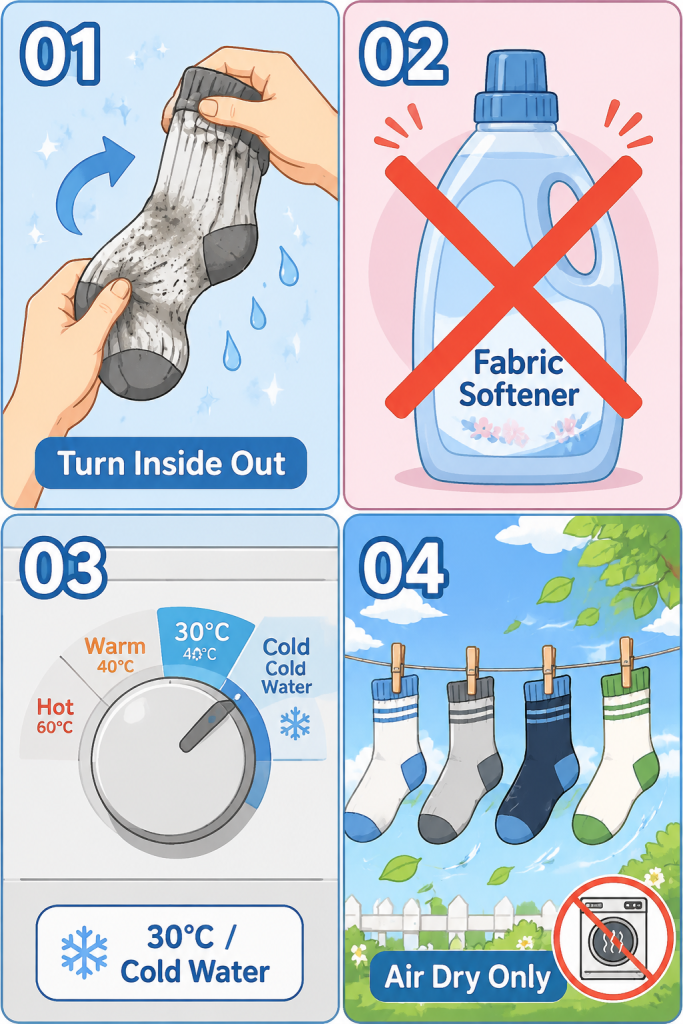
4 Easy Ways to Wash Socks So They Stay Dry & Fresh Longer
Proper care keeps your performance socks performing. Skip this and they’ll lose their magic fast.
Step 1: Turn socks inside out:Wash them inside out. That way, detergent and water hit the inner layer first—the part that touches your skin and holds the most sweat and oil. It cleans more effectively and restores the fabric’s wicking ability.
Step 2: Avoid fabric softener completely:This is not negotiable. Fabric softener applies a waxy film to the fibres. The film clogs the grooves in Coolmax and the pores in wool, killing their moisture-moving properties. Your socks will stop wicking, and you might as well have bought regular ones.
Step 3: Use cold or warm water only:Keep water below 30°C (approximately 85°F). Hot water can cause wool to shrink and weaken synthetics over time.
Step 4: Air dry instead of machine heat:Hang them to dry in a shady breezy spot. Don’t use the dryer. High heat damages spandex and causes socks to lose their shape and elasticity. Air drying is gentler, and keeps them fitting right.
Final Answer: What Is the Best Sock Material for Sweaty Feet?
So, the million dollar question: What Is the Best Sock Material for Sweaty Feet? If you insist, here is my honest recommendation for everyday wear: A quality merino wool or bamboo blend shoe won’t let you down, providing excellent sweat wicking capabilities while protecting feet from becoming overheated or too cold, not becoming a science experiment by evening’s end. But if you’re heading to the gym or pounding the track, and you really need that instant dry off, then a high‑tech polyester like Coolmax takes the crown. No contest.
So the real answer? It depends on what you do. That’s why having a small rotation of different sock types is the smartest move.
Looking to create your own line of performance socks? That’s where Implementer comes in.
You don’t need to wrestle with complex textile engineering. Implementer offers a full range of premium fabric solutions. Their lineup covers all the bases. You’ve got ultra‑soft combed cotton, naturally antibacterial bamboo, 100% natural wool, and durable nylon‑polyester blends. So whatever your brand is into – whether it’s outdoor hiking gear, high‑performance sports, or sharp business casual – they start with premium raw materials and dial in the exact blend ratio that fits what you’re making. Contact them today and they’ll help make your design ideas a reality.