
Small-batch vs. Large-batch Production of Custom Plush Toys
Custom plush toys have gained popularity for businesses, events, and the general market. From promotional mascots to collectible stuffed animals, one might ask: shall the custom plush toy manufacturer enter into large-batch production, or stay small-batch, at least for the first few samples? Both small-batch and large-scale production strategies come in advantages and limitations related to cost, flexibility, quality control, and market responsiveness . Understanding these differences can help businesses select the most suited method for custom plush manufacturing according to their specific requirements.
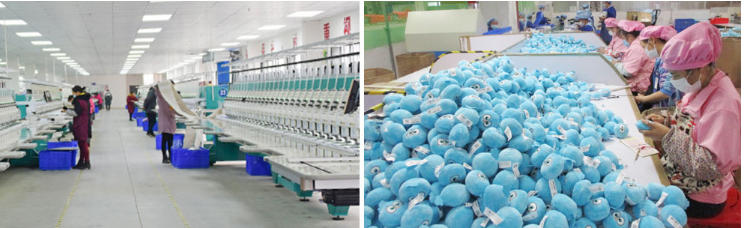
Understanding Small-batch Production of Custom Plush Toys
Small-batch production of custom plush toys means a method of producing plush products in relatively few numbers, usually ranging from some dozens to a few hundred units. This production method is commonly pursued by fashion start-ups, independent designers, promotional merchandise sellers, as well as new plush toy design debuts of various brands, focusing on customization, flexibility, and manageable investment to high-volume output.

In plush toy manufacturing, various stages must be carried out-at least in small quantities, such as patternmaking, fabric selection, embroidery setup, sewing, stuffing, and finishing-almost irrespective of the order’s magnitude. In limited-scale production, manufacturers can customize each process and exploit these advantages on a relatively small number of articles, thus offering the flexibility of a more personal and customized production of the plush toys. It is thus especially appropriate for the development of prototypes, limited collections, promotional mini-giveaways, and market niched products.
Advantages
- Greater Flexibility in Design: Small-batch production runs give the manufacturer the ability to modify design details including fabric lengths, colors, patterns for the embroidery, and choice of accessory. This flexibility allows a brand to instead experiment creative concepts and make adjustments to its stuffed toy design before proceeding to a mass-scale production.
- Reduced Inventory Risk: Making fewer amounts prevents risk of inventory overstocking in case of market uncertainty, a contingency enjoyed best by seasonal products, promotional merchandise, or fancy plush toys squeezed in here and there for a limited marketing pitch.
- Effective Market Testing: With few pieces in existence, it is possible for the organization to test the ambiance with one new plush-toy design. Thereafter, according to the customer response and sales performance, the producers may make adjustments to the require shape, size, material, and packaging before working in the large-scale manufacturing.
- Stronger Product Exclusivity: Limited production quantities can create a sense of scarcity and exclusivity. For collectors or loyal customers, small-batch plush toys may have higher perceived value, especially when associated with special collaborations or brand mascots.
- Better Customization for Specific Clients: Small-batch manufacturing is well suited for customized orders, such as customized corporate mascots, promotional gifts, or themed plush toys for events. The limited volume allows more attention to specific design requirements.

Limitations
- Higher Unit Cost: Fixed costs, such as sampling, pattern making and programming for embroidery, are imminent in plush toy production. These costs are then spread among the fewer toys produced leading to a higher unit price for the plush toy.
- Lower Production Efficiency: When factories optimize their workflows, they do so for large batches and not small ones, which are the most dreadful interference for normal processes and result in less efficiency and more production time.
- Possible Minimum Order Restrictions: It is found that some of the soft toy manufacturers might ask for minimum orders in order to be able to keep manufacturing costs low. Small orders are not easy to make because of their economic impracticality; they might have to be contracted out to some special custom manufacturers.
- High Material Prices: Along with a great many objects required in the manufacture of toys like substances, filling materials, or stock, summs very expensive ones, the most costly would have to be the material, if yes some inexpensive ones. This is certainly much cheaper in the long run when dealing with huge amounts of material, and in production carried out by tanking it in small amounts, many materials not get a discount for caliber.
- Scheduling Delays: The reason might be found in large orders existing for competitive clients. These generally precede: the further the pecking order goes, the more difficult it can be to schedule small orders, the degree depending on how much each factory’s current production capacity must go up.
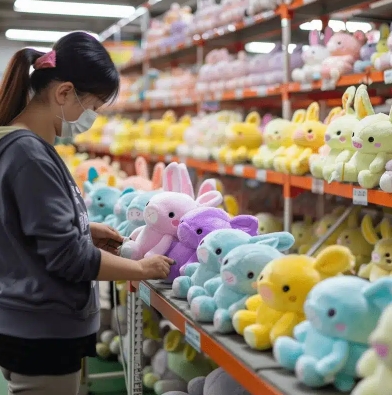
Understanding Large-batch Production of Custom Plush Toys
The custom plush toy manufacturing process is still an unspoken truth when the topic of large-scale production comes into the works. Large batches are about the critical success indicators for product-derived companies and mass retail concerns because major actors get to roll out big-scale promotional campaigns at low costs. This helps in putting cost-efficient and consistent production process that supports the merchandising and promotion of custom promotional campaigns.
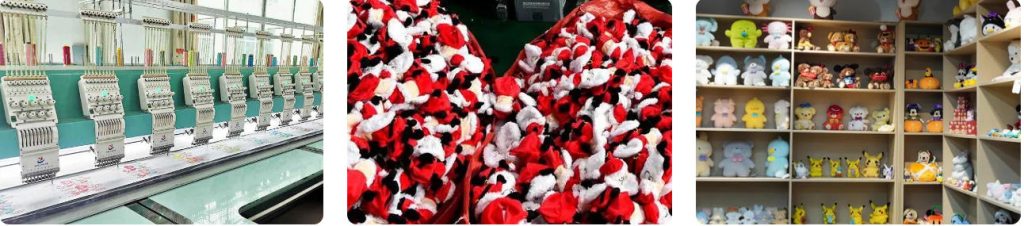
In the manufacturing of custom plush toys, if the production runs in large batches, the factory gives the employees room to optimize every feature of the production run-flow of optimized template making, fabric cutting, global embroidery, general sewing, stuffing, and so on. It is the most common method of producing these toys because even when they are in large production, big-batch production always offers all of them.
Advantages
- Lower Unit Cost: The first and foremost advantage of large-scale production is that it can reduce prices per unit. By spreading the cost of once-fixed items such as patternmaking, sampling, programming for embroidery, and setup of machines across a larger quantity, there is a vast reduction in the actual piece price of any plush toy.
- Higher Production Effectiveness: Having large batches to work with will help factories hone their production methods. With predictable materials and designs, cutting machines and embroidered cross-stitching systems will stay in near-constant operation, thus saving time, improving overall efficiency, and reducing production costs.
- Stable Product Consistency: Wherever large quantities using standard processes that ensure consistent quality throughout all units are concerned; this represents a true blessing for any brand that seeks homogeneity in the appearance and operation of their plush toy offerings.
- Better Material Procurement Costs: In mass custom plush production, an advantage is that a manufacturer can opportunistically have bulk purchases of fabrics, fillings, threads, and accessories. These materials will often attract considerable discounts, so that they act to further lower the total pricing of the goods that are being manufactured.
- Strong Supply Capability: For companies supplying large retail chains, online platforms, or global distributors, large-batch production ensures sufficient inventory to meet widespread market demand without frequent production interruptions.
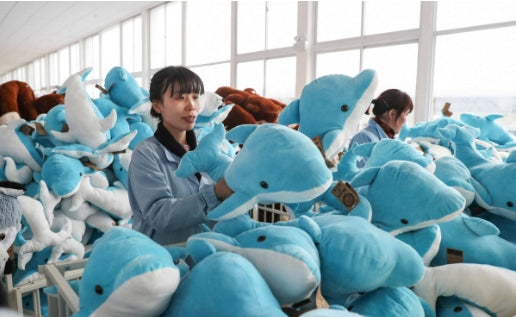
Limitations
- High Initial Investment: The major catch of bulk production of custom plush toys is the significant upfront investment. Before the toy is finally put up for sale, the company must spend on production costs, purchase of materials, and logistics.
- Greater Inventory Risk: If there is insufficient demand for this product, the consequent possibility is that the plush toy will find itself with excess stock. Excess inventory stock will give rise to increases in storage costs, thereby translating into withdrawals from company reserves in terms of financial losses.
- Limited Flexibility for Design Changes: At the start of commercial production, altering colors, materials, or embroidery details can interfere with the production process and bring costs up markedly.
- Longer Preparation Time: Large-batch production can lead to longer preparation time during the early stages, notably in regard to production planning, material sourcing, and assurance of quality. This will have a tremendous effect on the viable timeline for product development.
- Market Demand Dependency: Large-batch custom plush production runs more effectively with predictable, stabilized demand. Taking on large capacities without proven market demand can bring significant business risks.
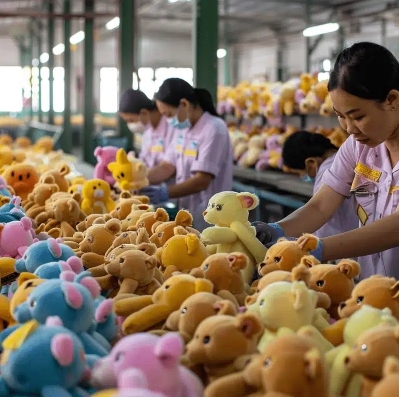
Key Differences Between Small-Batch and Large-Batch Production of Custom Plush Toys
| Aspect | Small-batch Production | Large-batch Production |
| Production Volume | Typically dozens to a few hundred units | Usually thousands to tens of thousands of units |
| Unit Cost | Higher cost per plush toy due to limited quantity | Lower cost per plush toy due to economies of scale |
| Setup Cost Distribution | Fixed setup costs spread over fewer items | Setup costs distributed across a large number of items |
| Design Flexibility | High flexibility for design adjustments and customization | Limited flexibility once production begins |
| Production Efficiency | Lower efficiency due to smaller runs and frequent adjustments | Higher efficiency with standardized and continuous production |
| Material Procurement | Materials often purchased in smaller quantities at higher prices | Bulk material purchasing reduces costs |
| Inventory Risk | Lower risk of excess inventory | Higher risk if demand is overestimated |
| Market Suitability | Ideal for prototypes, limited editions, and market testing | Suitable for retail distribution and large promotional campaigns |
| Lead Time | May vary depending on factory scheduling | Often optimized for faster large-scale production |
| Upfront Investment | Lower initial financial commitment | Higher upfront investment required |
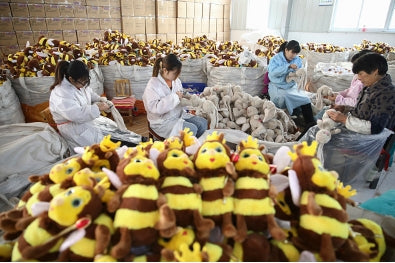
Key Factors to Consider for Choosing Between Small-batch and Large-batch Custom Plush Production
Selecting between small-batch and large-batch production of custom plush toys depends largely on business goals, budget, market demand, etc.
1. Market Demand and Sales Forecast
One of the most important considerations when choosing between small-batch and large-batch production is the expected market demand for the custom plush toy. If a product is new to the market and demand is uncertain, small-batch production allows companies to introduce the design with minimal financial risk. Businesses can observe customer reactions, analyze sales performance, and gather feedback before expanding production.
In contrast, when a company already has confirmed orders, strong brand recognition, or established retail distribution channels, large-batch production becomes more practical. A reliable sales forecast ensures that the produced inventory can be sold efficiently, helping companies fully benefit from the cost advantages of large-scale manufacturing.
2. Production Cost and Budget Planing
Production cost is another major parameter affecting the judgment. Smaller volumes of production reflect a higher cost per unit because the fixed setup costs, like pattern-making, sampling, embroidery programming, and setup of machines, are divided across fewer numbers. However, therefore, the overall commitment towards funds becomes lesser when looking at the generation of lesser schooshes.
On the flip side, large-batch production leads to a sharp decrease in per unit costs on account of economies of scale. Material purchase in bulk, smooth production lines with non-stop activities, and handling all the local staff well keep the cost structure attractive. However, larger upfront investment payouts are required and should be well budgeted in the company’s production budgets.
3. Inventory Management and Storage Capacity
Small-batch production has become increasingly significant as far as the implementation of inventory management is concerned. This would assure operating upon the leanest inventory levels for such companies, which is a function inversely proportional to that of large-batch stock. This is particularly useful for seasonal faux fur animals, base objects, or ‘limited edition’ ones.
While there is another side to the above argument: high inventory must find a harbor somewhere, usually, at a voluminous stock of surplus goods needing to be invested in due care concerning warehouse facilities and logistics. For the unprepared, meaningless piles of products thrown into the inventory certainly move toward wasting money-so that overstocking can be viewed as a potential liability to a stored lifetime.
4. Product Design Stability
Another significant aspect of a design for custom plush toys is its stability. In a scenario where a design is still in the making and may be subject to some constant changes in real-time, a small-batch production becomes extremely flexible for any re-modifications. Modifiable aspects such as fabric choices, embroidery patterns, color combinations, or accessories would be handled carefully within any consecutive production run at this stage, too.
Large-batch production applies more to designs that have already been finalized and approved by their consumers. Upon beginning mass production, any changes to their design would mean an extra cost and a loss of production time.
5. Production Schedule and Supply Requirements
Production schedule and delivery requirements govern to a great extent the choice for small runs or large ones. Small-batch production can have an advantage of a later start in terms of total preparation but may face scheduling delays based on factory capacity. Order priority can also impact this.
Large quantity production will usually require rigorous groundwork involving sourcing materials, production scheduling, and requisite quality control. Still, this brutal preoccupation with the preparation becomes more meaningful as soon as the machine starts working; then, the company secures “cumulative reduction in cost,” which renders it a cost-effective choice in retail investment or any such forward-thinking promotional campaign.
6. Brand Strategy and Product Positioning
Brand strategies would also be important in determining suitable production choices. Companies that wish to manufacture some specialized or more elite collectible plush toys can choose intentionally modest production as a rule so as to maintain scarcity and originality. It’s true that limited edition plush toys would require constructive brand positioning and unique appeal for them to beckon the internal-review collector.
On the other hand, brands targeting the mass markets, retail chains, or other global distribution, usually rely upon large-batch production to keep a consistent supply and competitive pricing. The scale of production chosen should be aligned with the company’s overall marketing and product positioning strategy.

Summary
- Being flexible while reducing financial risk, small-batch production of custom plush toys is thus better suited for testing new designs, limited-edition production, or niche-market sector.
- Large-batch custom plush production is quite easy on the pocket and is especially good for stable demand products to ensure economy of scale and and large-scale distribution.
Implementer has been one of the most trusted custom plush manufacturers to create plush toys to meet the demand for both small batches and large batches. With flexible manufacturing capabilities, Implementer supports startups, brands, and organizations that require limited-edition plush toys as well as companies needing large-scale production for retail or promotional distribution. Implementer has rich expertise in craftsmanship to the innovative production technologies of today to remain competitive and accessible to the orders in varying volumes demanded of the group.
Future Trends in Small-batch and Large-batch Custom Plush Toy Production
Bothibilities decrease as the gap gets increasingly much narrower with regard to emerging digital design tools, programmer-driven automated embroidery machines, and the lean reflex manufacturing paradigm. Custom plush toy manufacturing in the factories is becoming ever more effective and cost-effective.
| Trend | Impact on Small-batch Production | Impact on Large-batch Production |
| Digital Design | Enables designers to quickly develop and modify plush toy concepts, making small production runs more efficient and accessible | Improves design accuracy before mass production, reducing errors and rework in large-scale manufacturing |
| Flexible Manufacturing Systems | Allows factories to handle customized and low-volume orders more efficiently | Supports smoother transitions between different product lines in high-volume production |
| Automation in Sewing and Cutting | Helps reduce labor costs and improve consistency even for small production quantities | Significantly boosts productivity and lowers per-unit cost in large production runs |
| On-Demand Manufacturing | Encourages production of plush toys only when orders are placed, reducing inventory risk | May support hybrid models where large manufacturers produce core designs while offering customized variations |
| Sustainable Materials and Eco-friendly Production | Enables niche brands to create environmentally conscious plush toys in limited quantities | Drives large manufacturers to adopt sustainable fabrics, recycled fillings, and greener production processes |
| E-commerce and Direct-to-Consumer Sales | Makes it easier for small brands to launch limited-edition plush toys and test new designs | Increases demand for large-scale production to support global online retail markets |
| AI-assisted Design and Customization | Allows personalized plush designs and faster customization for small-batch production | Helps optimize production planning, quality control, and supply chain management for large batches |
| Hybrid Production Models | Encourages companies to start with small-batch testing before scaling up | Supports scaling from validated small batches to full mass production once demand is confirmed |
Final Thoughts
Between small-batch and large-batch production modes, an extent, they carry crucial significance to the custom plush toy industry. By weighing considerations such as inventory management, design quality, production schedule and branding strategy, businesses can select the most efficient production strategy for custom plush toys, thus witnessing handsomely increased operational efficiency and sustained growth in a fiercely competitive market.