
Plush Slippers: How to Get Custom Designs for Your Brand or Event
Here’s an idea that most people overlook: plush slippers. So you’re looking for a gift. Something useful, but also something people will actually remember. For your brand. Or a company event. Or maybe just for your team.
A water bottle? Everyone gives those. A T-shirt? Someone wears it once, then it ends up in the back of a drawer. But a nice pair of custom plush slippers? That’s different. People wear those when they finally sit down and relax. And right at that moment, your brand pops into their head.
So this article is talking about what kinds of plush slippers are out there. Which materials are actually good. Which industries are already using them. And most importantly, how you can get your own custom order started from zero. We’ll keep it simple. No fancy words. No long, boring detours. children.
What Exactly Are Plush Slippers? And Why Everyone Loves Them?
What they are
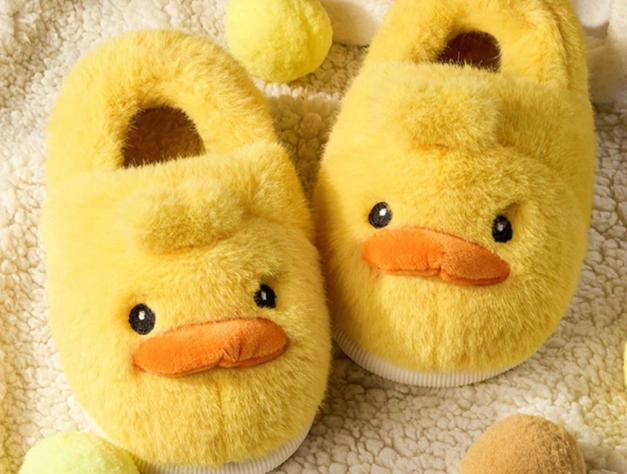
Okay, first thing. A plush slipper is basically an indoor shoe. The upper and the lining are both made of soft, fuzzy fabric. Regular cotton slippers? Those have shorter, thinner fur. Plush ones are thicker, denser, and way softer. A lot of them are shaped like animals or cartoon characters. You could almost call them “stuffed animals you wear on your feet.”
Why people love them
It’s not just about keeping your feet warm. Honestly, it’s more about how they make you feel. Cute. Relaxed. You post a pair of shark slippers or panda slippers, and people will like it. For a business, here’s the smart part. You put your logo on those slippers. Now your brand is sitting quietly in someone’s private space. Every time they wear them, they think of you.
Popular Types of Plush Slippers
Alright, let’s talk about the main types you’ll actually find out there. Basically three kinds. Knowing the difference helps you figure out what you really want.
First, animal plush slippers. Yeah, you’ve seen them. Sharks, bears, rabbits, pandas, dinosaurs. You name it. They have little eyes, ears, mouths, and even teeth. Young people absolutely love these. Great for fan merchandise, anime conventions, and campus events.
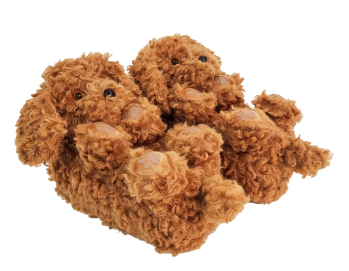
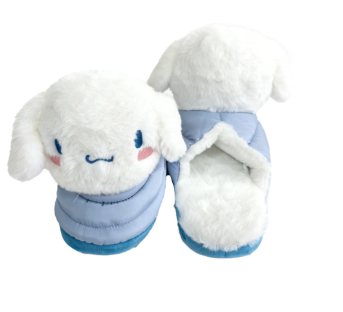
Second, character or IP plush slippers. These are based on existing characters from anime, games, or cartoons. Hello Kitty, Pikachu, stuff like that. One catch, though. You usually need a license. Unless you own the IP yourself. Like, if you’re an illustrator and you want to turn your own character into slippers. Then it’s fine. You see these a lot in fan communities and merch shops.
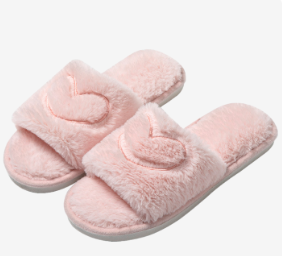
Third, simple, solid color plush slippers. No animal shapes at all. Just one color. Or maybe a simple color block. Clean, elegant, not childish. That’s why they work really well for corporate gifts, hotel slippers, spa slippers, and employee rewards. You can put your logo on the upper, on the sole, or on a hang tag. And it won’t mess up the clean look.
Best Materials for Plush Slippers
To judge the quality of a custom plush slipper, look at four parts: outer plush fabric, inner lining, slipper sole material, and filling. Here is a plain‑language explanation of each one and when to use it.
Outer fabric
Short plush. Fur length about 3 to 5 mm. Doesn’t shed, easy to clean. Good for corporate gifts.
Long plush. 1 to 2 cm. Softer, cuter, but it can get matted. Great for animal shapes.
Sherpa. Curly, chunky fur that looks like lamb wool. Very warm. Good for winter styles.
Faux fur. Looks and feels premium. Costs more. Best for high‑end gifts or retail.
Beyond just the feel, understanding how plush fabric enhances the design of custom plushies can help you choose a texture that makes your brand’s character or mascot look more vibrant and professional.
Inner lining
This is the layer inside the shoe. A good lining uses the same material as the outer fabric. Short plush or coral fleece. That way it feels comfortable when you wear them without socks. Cheap slippers use plain cotton inside. Feels much worse. So when you customize, ask for the same material inside and outside.
Sole
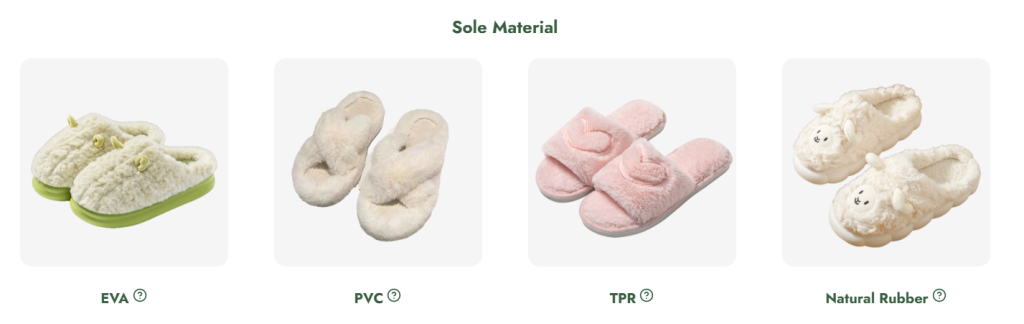
People ignore the sole. But it’s super important. There are four common materials.
TPR (thermoplastic rubber). Good slip resistance, durable, and a bit flexible. Recommended for corporate gifts and daily home use.
EVA. Very light, like the midsole of a running shoe. Slip resistance is just okay. Fine for wooden floors indoors.
PVC. Hard, cheap, but it gets slippery in winter and cracks easily. Not recommended.
Natural rubber. Excellent grip. Very elastic. Soft to step on. But it costs 20% to 40% more than TPR. And if the formula or storage isn’t right, it can get sticky or smell a little. Best for nursing homes, hospitals, and high‑end spas where slip resistance is critical.
Filling
That’s the soft stuff between the upper and the sole. High‑density foam bounces back well. Memory foam molds to your foot but costs more. Cheap slippers use scrap foam that flattens after a few days.
Practical advice
So here’s a quick tip for corporate gifts. Go with a TPR sole, short plush outer, and high‑density foam filling. That combo just works. Now, if you really need extreme slip resistance, like for elderly people or a medical facility, consider natural rubber. It costs more, but it’s safer on wet floors. For most normal cases, though, TPR is the safe and reliable pick.
Industries That Use Plush Slippers
Plush slippers aren’t just for wearing at home anymore. Seriously. Six industries use custom plush slippers all the time. If you work in any of these, you’ll quickly see why customization makes sense.
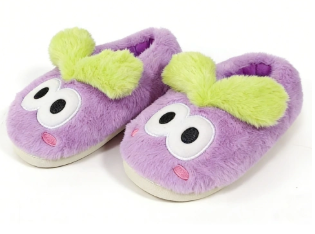
Hospitality. That means hotels, spas, and resorts. High‑end hotels often put logo‑printed plush slippers in guest rooms as a welcome gift or a minibar item. Spas use them to make the changing experience nicer. And the benefit? Guests take those slippers home. Every step they take at home is free advertising for the hotel. Pretty smart.
Corporate gifting and employee rewards. A lot of companies give out warm gifts during the Mid‑Autumn Festival, Chinese New Year, annual dinners, or work anniversaries. Plush slippers actually create a stronger emotional connection than a water bottle or a power bank. Why? Because people use them when they relax. You can add your company logo, brand colors, or even a little slogan on the sole.
Retail and e‑commerce. Sellers on Etsy, Amazon, and Shopify are always hunting for products that stand out. Custom plush slippers, especially animal shapes or niche designs, help them avoid price wars. For example, there’s a seller who makes French bulldog shaped slippers. They charge twice what normal slippers cost. And fans happily pay.
Events and entertainment. Fan meetings, anime conventions, music festivals, and university orientation events. They all love limited edition souvenirs. Plush slippers are a natural fit. People can actually use them, and they also love showing them off on social media. You can print the event date, a slogan, or a mascot right on the slippers.
Healthcare. Hospitals, rehab centers, nursing homes. They need slippers that are warm, slip resistant, and easy to put on. For patients and the elderly. The customization here isn’t really about branding. It’s about identification. For example, using different colors for different wards, or printing the bed number directly on the slippers. And slip resistance? Extremely important.
Pet and animal brands. If you run a pet‑related business, like a pet food company or a pet hospital, or if you own a popular animal influencer, you can turn that animal’s image into plush slippers. Fans buy them because “it looks just like my dog.” These orders are often small in quantity but the unit price is higher.
Even if your industry isn’t on this list, don’t worry. Custom plush slippers can still help any organization that wants to be remembered.
The Problem with Off the Shelf Plush Slippers
You can go on Amazon and find tons of plush slippers. Easy. But if you’re buying for a brand, an event, or a team, the ready‑made ones usually have three big problems.
1. They all look the same
Search “plush slippers” on any shopping site. The first 20 pages are almost identical. Either a shark, a bear paw, or some boring plaid print. Your brand will never stand out in that crowd. Worse, your competitors can buy exactly the same pair. No difference at all.
2. No good way to add your logo
Most regular slippers aren’t made to have a logo added later. Even if you try to print one, it comes off fast. Heat transfer on furry fabric? Cracks after two washes. Embroidery? A factory isn’t going to change its whole production for one or two pairs. Also, most off‑the‑shelf slippers don’t have space for sole debossing or a custom hang tag.
3. Wrong material, wrong size, wrong color
Your brand color might be dark green. But off‑the‑shelf slippers only come in gray, pink, or brown. You need extra large sizes for the men on your team. But the shelf only has “one size fits all.” You want a thicker, more slip‑resistant sole. But you can’t find a style that has it. These limitations make your gift feel like an afterthought.
So here’s the simple conclusion. If you care about brand expression, team spirit, or making an event memorable, ready‑made plush slippers won’t work. That’s why more people are going custom.
Custom Plush Slippers Are Easier Than You Think
When people hear “custom,” they think expensive. Huge minimum quantities. Complicated process. Actually, custom plush slippers are way simpler than you imagine. Let me walk you through a real five‑step process. Imagine a medium‑sized company that wants 200 pairs for employee welfare.
Step 1: Tell us your idea
You don’t need to be a designer. Just tell us what animal, what color, roughly what it should look like. A hand‑drawn sketch. A few reference pictures from the internet. Or even just text like “a penguin wearing a scarf.” The factory’s design team can turn that into a production‑ready drawing.
Step 2: Get a sample
The factory makes one or two sample pairs for you. This usually takes 10 to 15 days, including shipping. You’ll receive real slippers. You can feel the fabric, see the colors, try them on. Then you can ask for changes until you’re happy. There’s a sample fee, but most factories will deduct it from your bulk order when you reach a certain quantity.
Step 3: Lock down the details
Now you decide. Which fabric from the list above? Which sole material? Embroidery or printing? Where does the logo go? On the upper, the sole, or the hang tag? Once everything is confirmed, the factory issues a production confirmation sheet.
Step 4: Small batch production
Here’s something many people don’t know. The minimum order quantity for custom plush slippers can be quite low. For a simple solid color style with embroidered logo, 100 pairs is doable. For complex animal shapes that need a custom mold, the MOQ might be higher, like 500 to 1000 pairs. But for most corporate gifts or team events, 100 to 300 pairs is a very common range.
Step 5: Add custom packaging
You can also choose matching packaging. A non-woven dust bag with your logo. A custom hang tag with a short message or your brand story. Or even a gift box. Small packaging details make people much more likely to take a photo and share it. To help you stand out, you can explore what are effective packaging solutions for custom plush toys to find the perfect match for your brand’s aesthetic and shipping needs.
From your first inquiry to receiving your bulk order, expect about 45 to 60 days. That includes sampling and production. If you’re not in a rush, it’s totally manageable.
Three Ways to Make Custom Slippers Look Brand Quality
Some custom slippers look like cheap freebies. Others look like real, thoughtful brand gifts. The difference isn’t always about price. Often it’s three small details. If your budget is tight, spend your money on these first.
1. Embroidery vs. heat transfer
The most durable way to put a logo on furry fabric is embroidery. Embroidery uses colored thread to stitch the pattern onto the upper. It feels 3D. It survives machine washing. It doesn’t peel. The downside? Slightly higher cost. And it doesn’t work well for very tiny text.
Heat transfer prints the pattern on a film and then uses a heat press to stick it onto the fabric. You can get very complex, full‑color images. But over time, the fur gets flattened and the pattern can crack.
My suggestion? For corporate gifts or daily‑wear slippers, go with embroidery. For one‑time event giveaways, heat transfer can save you money.
2. Sole debossing or printing
The sole is a branding spot that a lot of people forget. You can deboss or print your brand slogan or logo on a TPR sole. Every time the wearer lifts their foot, someone else sees it. The tooling cost is very low. The extra cost per pair is almost nothing. But the effect is surprisingly memorable.
3. Custom packaging
The moment someone opens a gift decides their first impression. You don’t need an expensive box. Three low‑cost ideas work really well:
- A custom dust bag. Canvas or non‑woven, printed with your logo. The recipient can reuse it for other things.
- A custom hang tag. A thick paper tag that tells your brand story, a care instruction, or just a simple “thank you.”
- A sticker seal. A branded sticker on the poly bag closure. Small but classy.
The total extra cost for these three details is usually less than 10% of the per‑pair price. But they make the recipient feel like your brand actually cares. That’s money well spent.
Why Choose a Professional Factory Like Implementer?
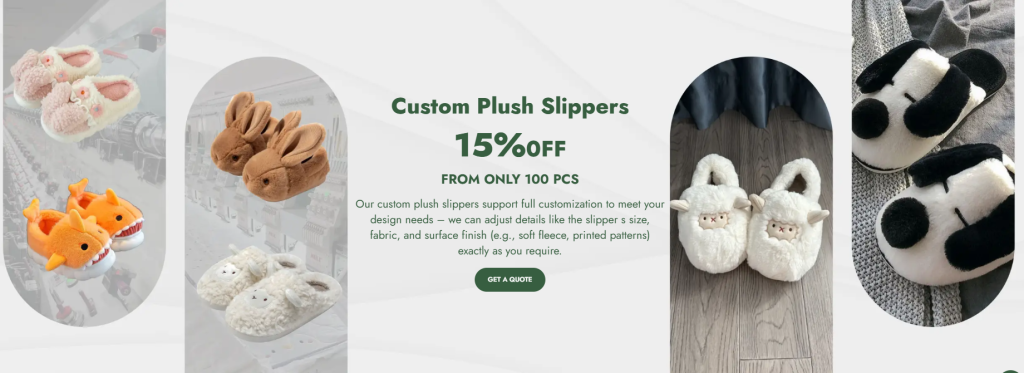
Let’s use Implementer as an example. We’re a factory that makes plush toys and custom plush slippers. Here are some facts. You can decide if we fit your needs.
Low MOQ, small orders possible. For simple styles, we can go as low as 100 pairs. You don’t need to order thousands just to try the market.
We cover common styles. Animal shapes (sharks, bears, rabbits), cartoon IP collabs, holiday themes (Christmas, Chinese New Year). We have multiple sizes for adults and kids.
Safe, skin‑friendly fabric. The upper uses soft plush that keeps feet warm and doesn’t irritate skin. Every pair goes through QC before shipping. No loose threads, no detached soles.
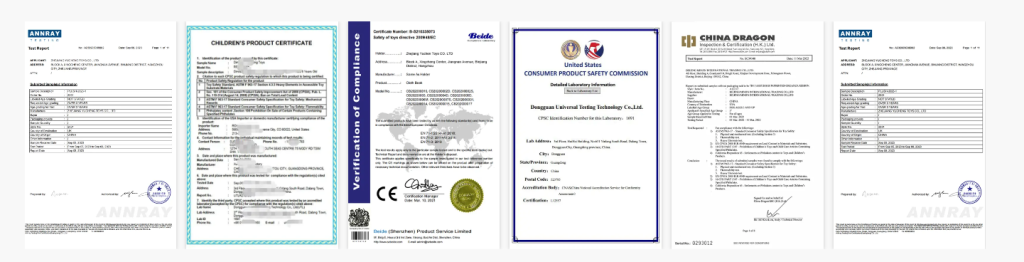
Safety certificates. If you export to Europe or the US, you need test reports. We can provide EN‑71, ASTM, CPSIA, CPC, and others. These prove the products don’t contain harmful substances above legal limits and are safe for the target age group. Very important for cross‑border e‑commerce and corporate gifts.
High‑quality embroidery and printing. We have professional embroidery machines and heat transfer equipment. Embroidered logos are full and stable. Printed patterns are sharp with rich colors. You won’t see the logo peeling off after a few days.
Real past work. We’ve worked with hotel chains, cross‑border e‑commerce sellers, and event organizers. If you’re interested, we can send you real photos of samples or bulk production for reference.
If the above sounds like what you need, feel free to just have a conversation with us about your idea. No need to decide right away. We can help you evaluate design feasibility for free. Give you a rough price estimate. Tell you how long production usually takes. Zero pressure.